


The Americans with Disabilities act ensure people of all abilities are able to safely and fully access public facilities. These standards help promote accessibility through clear signage, accessible walkways, and more. But failing to meet ADA signage standards can cost restaurants thousands in fines and lawsuits. To comply, signs must meet specific design, placement, and readability requirements, ensuring accessibility for all customers, including those with disabilities. Some examples include:
- Tactile signs: Required for permanent rooms like restrooms and exits, featuring raised characters, Grade 2 Braille, and high-contrast visuals.
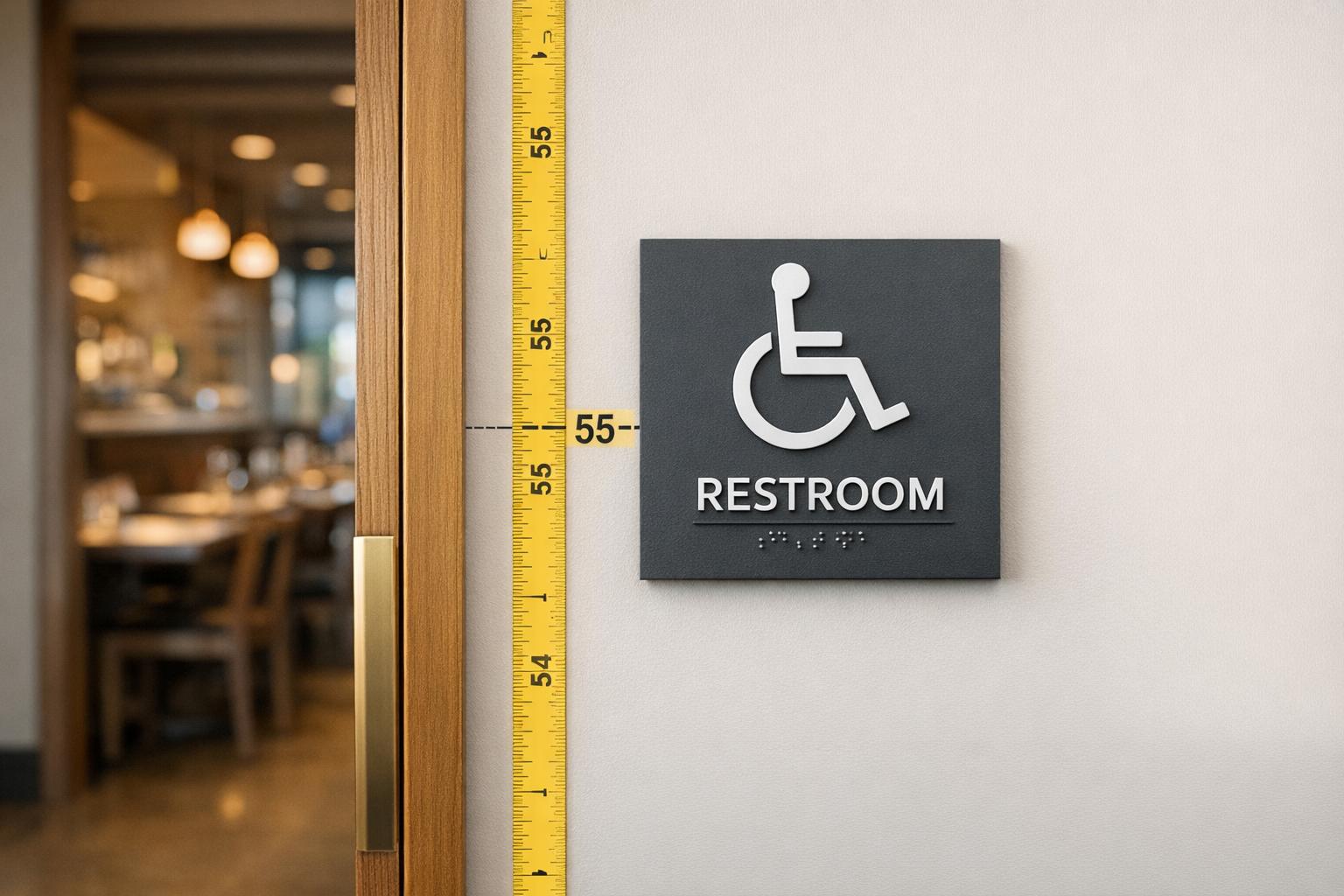
- Placement: Mount tactile signs 48–60 inches from the floor, on the latch side of doors. Ensure an 18-inch by 18-inch clear floor space for wheelchair access.
- Design rules: Use sans-serif fonts, non-glare finishes, and maintain a 70% contrast ratio.
- Directional and informational signs: Visual-only, exempt from tactile requirements but still require clear readability.
Non-compliance risks costly fines and potential lawsuits. Brands can mitigate these risks with regular inspections and working with professional signage providers.
ADA Signage Standards Explained
ADA Signage Requirements Comparison: Permanent Room vs Directional Signs
Navigating the ADA signage standards can be complex, but is key to ensuring compliance and creating an inclusive environment. The ADA categorizes restaurant signage into two main groups. Permanent room identification signs – like those for restrooms, kitchens, offices, storage rooms, and exit doors – must include both tactile and visual elements. On the other hand, directional and informational signs, such as “Accessible Entrance This Way” or “Hours of Operation,” only need to meet visual requirements and don’t require raised characters or Braille. Below is a breakdown of the required signage types and the design standards that promote readability.
“One weak location never stays local. When a restaurant in Chicago fails ADA standards, that violation appears next to your Dallas and Phoenix stores online.”
- David Rigbye, Operandio
Required Signage Types
For all permanent spaces – such as restrooms, kitchens, offices, storage rooms, cafeterias, and exit routes – tactile and visual signs are mandatory. If certain entrances, restrooms, or checkout aisles are not accessible, they must be clearly marked with the International Symbol of Accessibility (ISA).
Directional signs, like those pointing to accessible entrances, must meet visual standards, while purely informational signs (e.g., “No Smoking” or operating hours) are also visual-only. However, some items, including menus, building directories, temporary signs posted for seven days or less, and occupant names, are exempt from ADA technical specifications. By adhering to these guidelines, restaurants can ensure compliance while fostering an inclusive experience for all guests.
Design Requirements for Readability
Tactile signs used to identify permanent rooms must follow specific design rules. They should use uppercase, sans serif fonts and avoid decorative, italic, or script styles. Raised characters must measure between 5/8 and 2 inches tall and stand out at least 1/32 inch from the background.
For tactile signs, Grade 2 Braille is required, with dots that are domed or rounded and placed directly below the corresponding text. All signs must feature a non-glare finish, such as matte or eggshell, and maintain a 70% contrast ratio between the text and background. If a pictogram, like a restroom symbol, is used on a permanent room sign, it must be set in a field at least 6 inches high with tactile text placed directly below.
Visual-only signs allow more flexibility, as they can use mixed case lettering, but the characters must still follow standard, easy-to-read forms.
| Feature | Permanent Room – Tactile | Directional/Info – Visual |
|---|---|---|
| Case | Uppercase only | Uppercase, lowercase, or mixed |
| Style | Sans serif only | Conventional (no italics/script) |
| Min. Height | 5/8 inch | 5/8 inch (adjusted for distance) |
| Stroke Width | Up to 15% of character height | 10% to 30% of character height |
| Braille | Required (Grade 2) | Not required |
Sign Placement and Mounting Rules
Placing signs correctly is just as important as designing them well. ADA guidelines provide clear instructions for mounting signs to ensure they can be easily found and read by all guests. These rules cover tactile character height, placement near doors, and maintaining clear floor space for wheelchair users. Following these guidelines helps restaurant operators stay compliant with ADA standards.
Mounting Height and Position Standards
- For tactile signs marking permanent rooms, the characters should be positioned 48–60 inches from the floor, measured from the baseline of the text. Visual-only signs, such as directional markers or informational postings, need to be mounted at least 40 inches above the floor. Overhead signs, on the other hand, must allow a minimum of 80 inches of clearance.
- When placing signs near doors, they should be mounted on the latch side – the side with the door handle. For double doors, if only one leaf is typically used, the sign goes on the fixed (inactive) leaf. If both leaves are active, the sign should be mounted on the wall to the right of the right-hand door. If no wall space exists on the latch side, the sign can be placed on the nearest adjacent wall.
- It’s also crucial to provide an 18-inch by 18-inch clear floor space centered on the tactile characters. This space must fall outside the 45-degree swing arc of the door, allowing wheelchair users to approach the sign and read it by touch. As noted by the U.S. Access Board, “Tactile requirements primarily apply to signs typically located at doorways because doorways provide a cue for locating signs by touch”. These mounting standards ensure proper visibility and accessibility, paving the way for marking accessible routes effectively.
Marking Accessible Routes and Entrances
Signage isn’t just about marking doors – it also plays a key role in guiding guests through the space. If your restaurant has multiple entrances but not all are accessible, the International Symbol of Accessibility (ISA) should clearly mark the compliant entry points. At inaccessible entrances, directional signs can guide guests to the nearest accessible door. The same logic applies to restrooms if not all facilities are accessible.
Within the restaurant, directional signs along accessible routes help guests find seating areas, restrooms, and exits. These visual-only signs should be mounted consistently at or above 40 inches from the floor to maintain uniformity. Additionally, any signs mounted on posts or pylons with leading edges between 27 and 80 inches in height must not stick out more than 12 inches into walkways. This ensures pathways remain clear and safe for everyone.
How to Achieve ADA Compliance
Start by pinpointing the areas that need permanent identification, such as restrooms, exits, and meeting rooms, as well as those requiring directional or informational signage. Once you’ve identified the needs, ensure your designs align with ADA standards. This means using sans-serif fonts like Arial or Helvetica, choosing non-glare matte finishes, and sticking to high-contrast color schemes (e.g., white on blue or black on white). For permanent room signs, include Grade II Braille and raised characters. By following these guidelines, you can merge thoughtful design with practical execution to meet ADA compliance requirements.
Working with Signage Providers
North American Signs offers comprehensive support through the entire process – from design to material selection and compliance checks. They help create design mockups and recommend durable materials like acrylic, aluminum, or photopolymer, ideal for high-traffic areas. Their expertise ensures your signs meet federal standards, including proper character heights (5/8 inch to 2 inches), stroke thickness, and tactile elements. They also assist with state-specific regulations, like California’s rule for 12-inch blue geometric shapes on restroom signs. By addressing design issues early, they ensure your signs meet contrast and font requirements before production begins.
Professional Installation Methods
Accurate installation is critical for ADA compliance. Professional installers ensure signs are mounted at the correct height – between 48 inches and 60 inches from the finished floor – and placed on the latch side of doors. They also ensure an unobstructed 18-inch by 18-inch clear floor space for accessibility. For businesses with multiple locations, North American Signs coordinates with a network of trusted installation partners, maintaining consistent standards across all sites.
Maintenance and Regular Inspections
Compliance doesn’t end after installation – it requires ongoing maintenance. Schedule regular inspections to clean signs for better readability and check for damage or updates. Exterior signs, which face weather-related wear, need extra attention. Conducting periodic accessibility audits helps ensure pathways are clear and tactile signs remain functional. Routine maintenance not only improves safety and accessibility but also helps protect your business from potential fines or lawsuits.
Working with Professional Signage Companies
Partnering with seasoned signage experts helps restaurant operators efficiently meet ADA standards while ensuring their brand remains consistent across all locations.
How Can We Help?
North American Signs offers a full range of ADA-compliant signage solutions. Our team manages every step – from creating design mockups that align with ADA standards to selecting durable materials like acrylic, aluminum, or photopolymer.
In addition to design and manufacturing, we’ll ensure proper installation so that signs meet mounting specifications and clearance requirements for compliance. We also offer preventative maintenance plans to ensure signage remains readable and adheres to evolving regulations.
Multi-Location Restaurant Solutions
For restaurant chains, maintaining consistency across locations is essential, especially when it comes to signage and compliance. North American Signs offers a centralized service model that ensures branding uniformity while navigating varying local ADA codes.
Our expertise in managing multiple locations is invaluable, particularly when dealing with different ADA standards. For example, locations built before March 15, 2012, may fall under the 1991 standards, while newer sites must comply with the 2010 regulations. By documenting these differences and ensuring each site meets its specific requirements, North American Signs helps protect a restaurant’s reputation and simplifies compliance across all properties.
Conclusion
Compliance Checklist
Restaurant operators can use this guide to ensure their ADA signage meets federal standards. Start by reviewing your current signage to identify any permanent rooms missing tactile or Braille signs. Check that accessible entrances display the International Symbol of Accessibility. Verify that all signage uses approved sans serif fonts as outlined earlier.
Make sure tactile characters are raised by 1/32 inch and installed at a height of 48 to 60 inches from the floor. Signs should be placed on the latch side of doors, with an 18-inch by 18-inch clear floor space beyond the door swing. Additionally, confirm that signs have a minimum 70% contrast and a non-glare matte finish. Regular inspections are essential to ensure signs remain securely mounted and that Braille dots are neither damaged nor painted over.
Following these steps sets the foundation for working with experts to maintain compliance and accessibility over time.
FAQs
Which restaurant signs must include Braille?
Signs that mark accessible areas, like restrooms and entrances, are required to include Braille. This ensures these spaces are accessible to individuals who are blind or have low vision, aligning with ADA standards for tactile signage.
How do I check if a sign meets ADA contrast rules?
To make sure a sign complies with ADA contrast requirements, ensure the characters have a non-glare finish and stand out clearly against the background. This means using either light text on a dark background or dark text on a light background, which improves readability for people with low vision. For accurate compliance, you can use contrast-checking tools to verify that the contrast ratio aligns with WCAG AA standards – at least 4.5:1 for regular text.
What’s the fastest way to audit ADA signage in my restaurant?
The fastest way to review ADA signage in your restaurant is by conducting a visual and tactile inspection with the help of an ADA signage checklist. Focus on essential elements like tactile characters, braille, proper contrast, correct placement, and pictograms (if applicable). This approach helps ensure you’re covering the basics. For a deeper dive into compliance, you might want to explore professional services or digital tools that simplify the process, often including features like photo documentation for added accuracy.
0 Comments